Accounting & trust money
Trust accounting
Rent held for landlords stays client money.
Ready to use today
How to use trust accounting
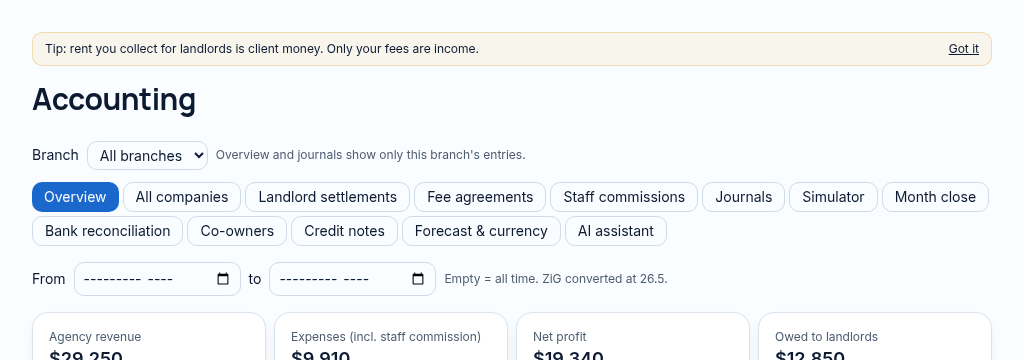
Rent held for landlords stays client money. Use it within Trust accounting & owner statements alongside the linked property, contact and transaction records, rather than maintaining a separate disconnected list.
The connected workflow
- 1.Check rent collected, the fee agreement version for the period, repair charges and landlord funds payable.
- 2.Calculate and approve the landlord settlement. Agency fees are revenue; landlord rent remains client money.
- 3.Pay the owner or separate co-owner shares and reconcile the statement. Never apply a new fee rate retrospectively.
Visibility follows your company, branch and section access. Important financial and approval actions remain subject to the app’s controls.
Why it matters
Agencies mix landlord rent with their own income and statements take days.
What changes
Real double-entry accounts where landlord rent is client money, never your income.
More in accounting & trust money
- Double-entry journalsEvery posting balanced, reversible, never deleted.
- Versioned fee agreementsManagement fees use the rate in force for that month.
- Owner statementsMonthly landlord statements with rent, fees and repairs.
- Month-closeCalculate, approve, pay, close and reopen a month.
- USD & ZiGWork in both currencies, with exchange-rate adjustments.
- Co-owner payoutsSplit landlord payouts between co-owners.
- Supplier bills & purchase ordersApprove and pay bills with approval limits.
- Fixed assets & depreciationAsset register with monthly depreciation.
- Combined company accountsStatements across several companies in one currency.
See PropertyFlow with your own portfolio.
Book a walkthrough, or start a 14-day trial and set up your first property today.